
Build your Emberville estate: workbenches, furnaces, farms, decorations, and why your homestead drives dungeon progress.
Emberville Estate Building: Your Homestead Hub
Quick answer: Your estate is your personal base inside Emberville — workbenches, campfires, furnaces, farms, and decorations you place yourself. It hosts your crafting stations, grows your food supply, and turns dungeon loot into dive-ready gear between runs.
What the Estate Is
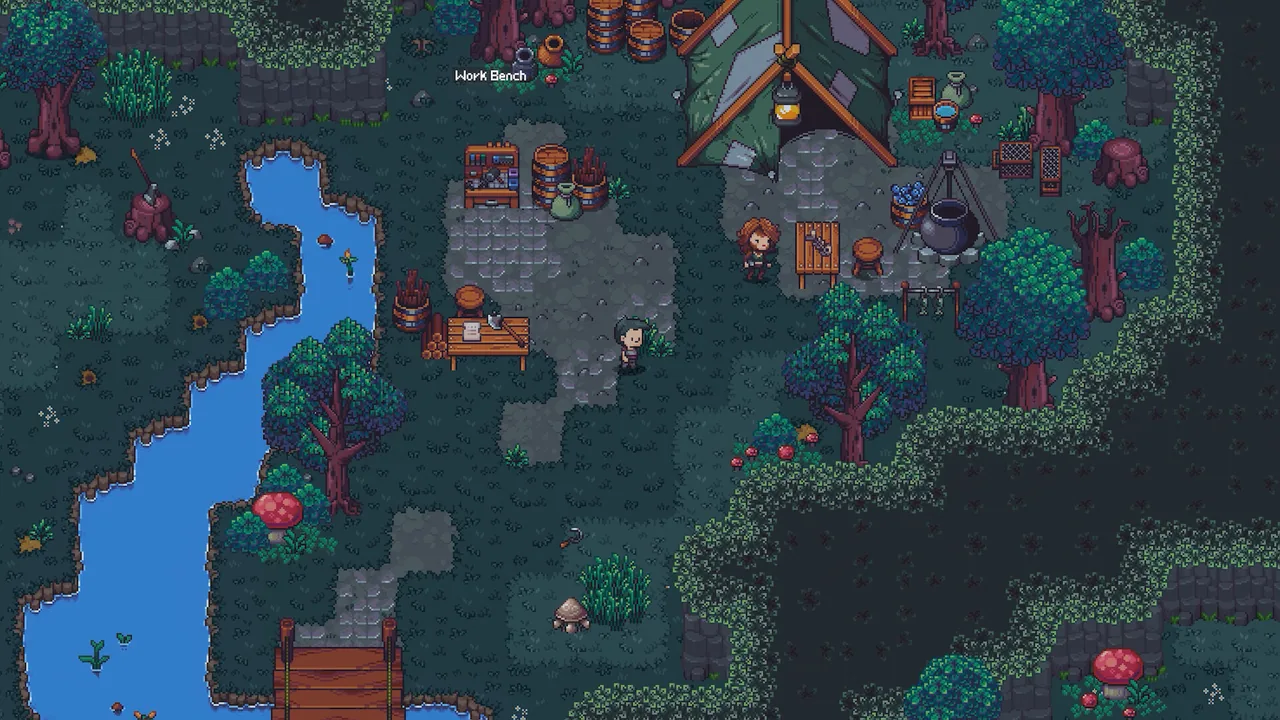
The Steam page gives the estate its own pillar: "customize your personal space… from buildings to furniture, plants, and decorations," and "craft anything needed to help your journey through the Vitromotus." Official screenshots show the reality — a riverside camp with workbench, anvil-side setups, campfire cooking, a dock, fenced crop fields, and a windmill farmstead with furnace rows.
Official source: Emberville on Steam
Estate Zones Worth Planning
| Zone | Purpose | Key structures |
|---|---|---|
| Workshop | Gear production | Workbench, anvil, Weaponsmithing/Armorsmithing stations |
| Kitchen | Battle supply | Campfire/cooking station, Alchemy setup |
| Farm | Food supply | Fenced crop plots, windmill, furnaces |
| Waterfront | Gathering | Dock for fishing, river access |
| Living space | Rest and flavor | Furniture, plants, decorations |
A "full creative building area" is promised for player expression — customization is called out as a core pillar alongside cross-class combat.
Estate vs Town Rebuilding
Two separate systems, one economy:
- Estate — yours. Personal crafting, farming, and decoration; progress at your pace.
- Town — shared. Rebuild Emberville by rescuing NPCs, who unlock workshops, shops, and trades (town guide).
Dungeon materials flow estate → gear → deeper dives → more materials. The estate is the engine room of that loop.
What to Build First
- Workbench + basic tools — gathering speed first.
- Cooking station — food before the Spider Matriarch.
- Crop plots — plant on day one; harvests compound.
- Storage and furniture — inventory pressure is real in the prologue.
- Decorations last — cozy, but gear first.
Estate Layout Principles
Space is presumably finite, so zone it like the screenshots do: production (workshop, furnaces) clustered for short crafting loops, farm beds near water, living quarters separate from industry. Keep paths clear between storage, workbench, and kitchen — you will run that triangle hundreds of times. Place noisy or smoky structures (furnaces, forges) downwind/downhill if placement affects anything; if it does not, at least your screenshots will look intentional.
Power, Water, and Roads (If They Exist)
Creative builders live or die on infrastructure rules — whether workshops need fuel lines, farms need irrigation, or distant plots need paths. Nothing is confirmed, but the screenshot evidence (furnaces colocated with fields, docks beside camps, fenced beds near water) suggests adjacency matters either mechanically or aesthetically. Build compact until proven otherwise: short supply lines are efficient under every ruleset, and a dense, legible homestead photographs better than sprawl. If EA reveals adjacency bonuses, compact builders collect them automatically; if not, nothing was lost.
The riverside camp composition is itself a tutorial: workbench beside the anvil-side setup, campfire within steps, dock at the water, plots fenced nearby. Copy that density — short walks compound into hours saved across a hundred-dive save file.
Creative Building: What "Full Creative Area" Implies
Customization "from cross-class combat skills to a full creative building area" is a headline pillar, which suggests placement freedom well beyond fixed plots — free building, rotation, decoration layering. Until EA confirms the toolset, assume: buildings placeable, furniture movable, plants decorative-or-functional, and a camera or photo affordance for showing off. The estate is the endgame for players who finish the story but keep perfecting home.
Day-One Estate Walkthrough
Concretely, your first session at the estate should run like this: arrive from the prologue with packed inventory, place storage first (inventory pressure kills momentum), set the workbench and basic tools second, light the cooking station third, fence and plant the first crop beds fourth. Then leave — crops grow while you dive, tools improve the next gather, food waits for the boss. Return between every descent: deposit, smelt, cook, replant, repair, re-dive. That six-verb return ritual is the heartbeat of the save file; players who ritualize it outpace players who "just quickly" chain dives without banking, because compounding crafting and farming XP quietly outruns raw combat XP across a long save.
Storage Discipline: The Unsexy Multiplier
Inventory pressure is the prologue's quietest killer — every full pack is a forced choice between valuable loot and gathered basics. Solve it structurally: central storage at the estate for crafting materials, a dive kit (weapon, food, potions, tools) that never gets deposited, and a vendor pile for surplus gear near the shop. Sort after every return while the run is fresh — mystery stacks become mystery trash within a week. The players who complain about inventory in month two are the players who skipped storage in week one; ten minutes of organization per session buys hours of unimpeded diving.
Can estate buildings be moved?
Unconfirmed, but relocation is the genre standard for creative builders — expect it. Until confirmed, place production first and decoration where it will not block future expansion.
Do estate structures need maintenance?
Nothing announced. If upkeep exists (fuel, repairs), furnaces and workbenches are the likely candidates — stock timber and basic materials as insurance regardless.
FAQ
Can I move buildings later?
Unconfirmed. Creative-area games usually allow relocation — expect it, but do not plan around it until confirmed.
Does the estate have NPCs?
Rescued townsfolk settle in town; whether they visit or staff your estate is unconfirmed.
Is there fast travel back to the estate?
Unconfirmed — but the return ritual (deposit, smelt, cook, replant, repair, re-dive) implies returns are frequent by design, whether by portal, settlement gate, or honest walking. Deep-dive logistics will be a launch-week discovery.
Deposit, smelt, cook, replant, repair, re-dive — six verbs between every descent. Players who ritualize it outpace players who chain dives without banking.
Sources
Related
More Emberville Guide Guides
Who makes Emberville: Cygnus Cross debut studio, CohhCarnage co-creator role, and the 22-actor voice cast with Amelia Tyler and Matt Mercer.
What Emberville EA includes at launch, what 1.0 adds — modding, bosses, biomes — and how community feedback shapes the year.
Every confirmed Emberville answer in one place: release date, co-op, price, platforms, classes, permadeath, demo, and system specs.
How farming works in Emberville: crop plots, Herbalism and Farming masteries, and turning harvests into food for dungeon dives.
Fishing, Mining, Smelting, and Woodcutting in Emberville: how gathering masteries level and feed your crafting and kitchen.
How Emberville gear works: dungeon loot, forging weapons and armor, potions, food, tools, and trinkets — all pre-launch confirmed.
The Knight is Emberville's defensive melee class: Raise Shield, Counter Attack, block scaling, and how to build around it.
Kymia is Emberville's emotion-born magic: it resurrects the dead, reshaped the prison into biomes, and fuels your Kymia Points.